
Innovative Composites & Industrial Coatings
Repair Protect Upgrade
Case Study:
The Complete Guide to Tank Base Sealing.
Protecting Your Industrial Assets: The Complete Guide to Tank Base Sealing.
The Hidden Threat Beneath Every Storage Tank.
Corrosion at the base of storage tanks is one of the most common and costly maintenance challenges faced across industries such as oil and gas, power generation, water treatment, and chemical processing. While the upper sections of tanks often receive routine inspection and coating maintenance, the base area frequently goes unnoticed until visible signs of deterioration appear.
Over time, rainwater, condensation, and atmospheric moisture can accumulate at the junction where the tank meets its foundation. This moisture collects in narrow crevices, where it remains trapped for long periods. The result is localised corrosion, pitting, and gradual wall thinning that compromise the structural integrity of the tank. Left unchecked, this can lead to leakage, contamination, or catastrophic failure, posing serious safety risks and environmental consequences.
Repairing or replacing a damaged storage tank is not only expensive but can also cause significant operational downtime. In regulated industries, environmental leakage incidents can also lead to legal penalties, reputation damage, and clean-up costs that far exceed the original maintenance budget. A proactive approach to corrosion prevention at the tank base is not just smart, it’s essential.


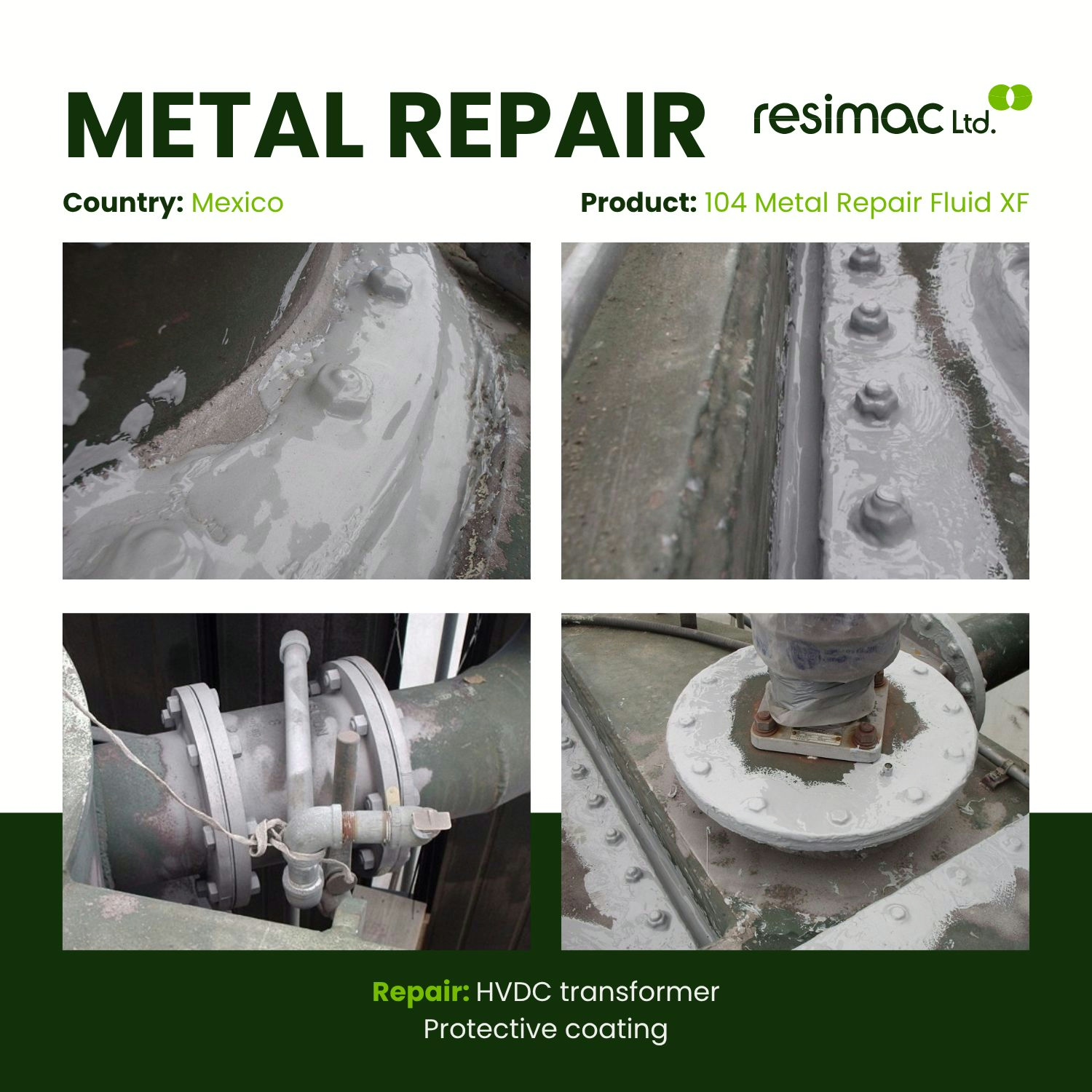
The Solution: Resimac SA’s Tank Base Sealing System.
Resimac has engineered a proven, long-term solution: the Tank Base Sealing System, a flexible and UV-resistant polymer composite designed to encapsulate and waterproof the circumference of the tank base. The system creates a seamless, durable, and breathable barrier that prevents water ingress while allowing residual moisture to escape through the polymer’s micro-porous structure.
In simple terms, it seals out external moisture but doesn’t trap internal dampness, a critical factor in ensuring long-term corrosion prevention. The result is a maintenance-friendly, highly durable system that provides lasting protection against environmental exposure and corrosion.
Why Tank Base Sealing Matters?
The importance of an effective tank base sealing system extends beyond corrosion prevention. It’s about:
- Asset longevity : Extending tank service life by preventing metal degradation.
- Safety and compliance: Reducing the risk of leaks that can cause contamination or safety incidents.
- Cost efficiency: Avoiding costly tank repairs, replacements, or downtime.
- Environmental responsibility: Ensuring storage systems operate safely within environmental regulations.
By combining flexibility, high adhesion, and weather resistance, Resimac’s Tank Base Sealing system delivers performance under the harshest conditions, protecting your investment and ensuring operational reliability.
Step-by-Step Process: From Preparation to Protection.
Achieving a successful seal requires careful preparation and correct product application. Resimac provides a detailed method to ensure optimal results:
- Surface Preparation.
Surfaces must be clean, dry, and free from rust, oil, or contaminants. For steel surfaces, abrasive blast cleaning to SA2.5 is recommended. When blasting isn’t feasible, mechanical abrasion with handheld grinders to ST3 is acceptable.
For concrete plinths, mechanical grinding removes loose material and deteriorated coatings. Any moss or lichen is treated with a fungicidal wash. Gaps between the tank and base are sealed using expanding foam or backer rod to ensure continuity in the sealing layer.
Proper surface preparation determines the system’s design life—up to 10 years with mechanical cleaning and up to 15 years with full abrasive cleaning.
- Priming.
Once surfaces are clean, apply Resichem 506 Aluprime, a high-performance solvent-based epoxy primer. Depending on the porosity of the concrete, one or two coats may be required. This primer ensures strong adhesion and enhances corrosion protection.
- Embedment Layer.
After the primer cures, apply Resichem 550 WR Membrane at a wet film thickness of 750–1000 microns. While still wet, embed 806 Reinforcement Mesh—a polyester technical fabric—into the surface. This mesh adds tensile strength and flexibility to the membrane, allowing it to adapt to thermal expansion and mechanical stress.
- Encapsulation Coat.
Once the embedment coat has cured (typically within 2–3 hours), apply a second coat of 550 WR Membrane at 400–500 microns to fully encapsulate the reinforcement. After curing, the result is a smooth, seamless, and UV-stable protective barrier.
Proven Performance: Tested and Trusted Worldwide.
Resimac’s Tank Base Sealing system is supported by comprehensive laboratory testing:
| Property | Standard | Result |
| Elongation | ASTM D412 | 160% |
| Tensile Strength | ASTM D412 | 600 psi |
| Direct Pull Adhesion | ASTM 4541 | 400 psi |
| Corrosion Resistance | ASTM B117 | >5000 hours |
| Water Vapour Permeability | ASTM E96-95 | 1 x 10⁴ perm.cm |
| Tear Strength | ASTM D624 | 17.3 kg/cm² |
| Ozone Resistance | ASTM D1149 | No cracking after 160 hours |
These results confirm that the system is both flexible and durable—capable of maintaining adhesion and protection even under harsh environmental conditions.
Case Study: Oil Refinery Success in Taiwan.
A major Taiwanese oil refinery faced corrosion problems at the base of 13 large storage tanks. Traditional coatings failed to provide long-term protection due to constant moisture exposure.
Working with a local Resimac contractor, the refinery adopted the Tank Base Sealing System. Both steel and concrete surfaces were mechanically prepared, primed with 506 Aluprime, and sealed using 550 WR Membrane with reinforcement mesh. Once cured, the system eliminated further moisture ingress while allowing trapped vapor to escape safely.
The result? Extended tank service life, reduced maintenance costs, and full confidence in corrosion protection, all achieved without removing the tanks from service.
A Comprehensive System for Long-Term Asset Protection.
What makes the Resimac system stand out is its complete integration of materials, each designed for a specific role in the protection process:
- 101 Metal Repair Paste: For small steel corrosion pits.
- 302 Epoxy Repair Cement: For larger steel repair areas.
- 570 Concrete Patch Repair XF: For concrete surface rebuilding.
- 506 Aluprime: For priming steel and concrete.
- 550 WR Membrane: The flexible encapsulating topcoat.
- 806 Reinforcement Mesh: Structural reinforcement for added strength.
Together, these products form a resilient, adaptable sealing system that can be installed quickly and maintained with minimal disruption.
Why Choose Resimac SA?
Founded in 2009 and headquartered in North Yorkshire, Resimac has become a trusted manufacturer of high-performance coatings and composites for industrial asset repair and protection, worldwide. With over 50 authorised contractors in 45 countries, Resimac provides global reach with local expertise, backed by 24/7 technical support. Our company’s philosophy—Repair. Protect. Upgrade.—reflects its commitment to extending asset life, reducing costs, and improving performance across marine, chemical, power, oil, and gas industries.
- Technical Expertise: Decades of experience in polymer engineering and industrial coatings.
- Global Standards Compliance: Repairs meet international quality and performance standards such as ISO 8501/4 and SSPC SP10/NACE 2.
- Proven Products: Resimac 101 and 203 are trusted worldwide for their exceptional durability and performance in demanding environments.
- Sustainability Commitment: Helping industries extend the life of their assets while reducing waste and emissions.
Conclusion: A Smart Investment in Corrosion Prevention.
Tank base corrosion may start small, but its consequences can be severe. The Resimac Tank Base Sealing system offers a reliable, cost-effective, and field-proven solution that not only stops corrosion in its tracks but also ensures long-term structural and environmental integrity.
In an era where operational safety and sustainability are paramount, proactive tank base sealing is no longer optional—it’s an essential part of responsible asset management.
Protect your tanks. Protect your future.


